
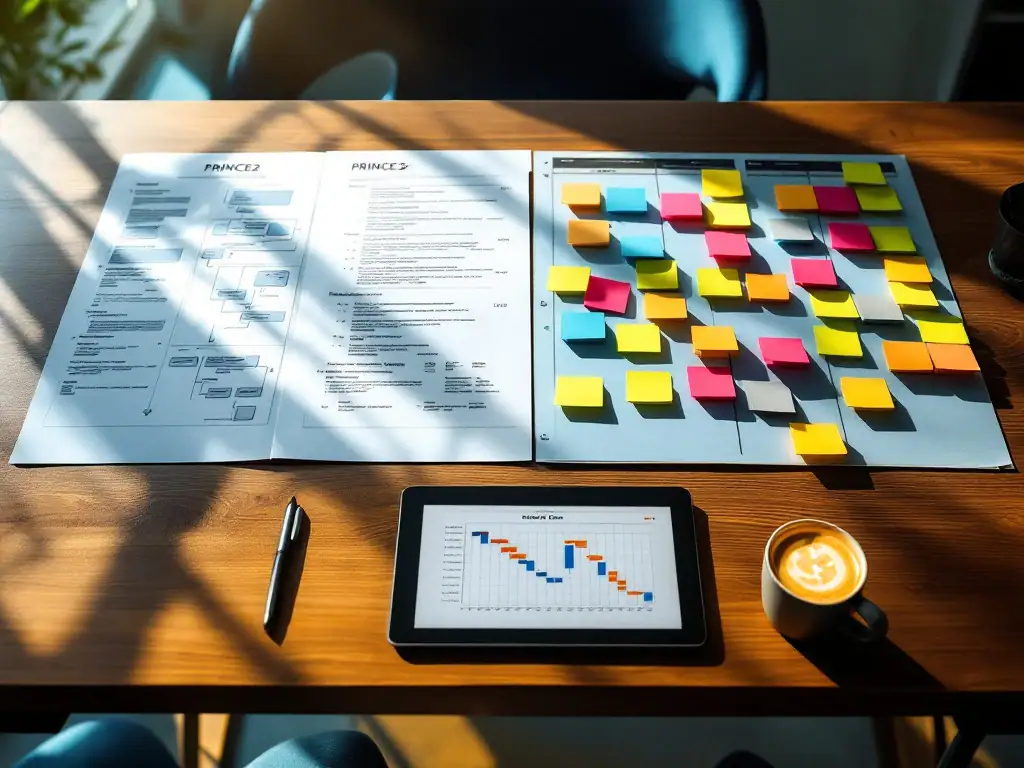
Combining PRINCE2 with other project management methods is a smart way to get the best of both worlds. You use the strong structure of PRINCE2 as a basis and enrich it with elements from flexible methods such as Agile or Scrum. We call this hybrid project management. You pick the parts that are most valuable for your project and leave out what is less relevant. This approach gives you both the necessary structure and flexibility to make complex projects a success.
What exactly does combining PRINCE2 with other methodologies entail?
Combining PRINCE2 with other methodologies means creating a hybrid approach that leverages the strengths of different methods. PRINCE2 provides a robust framework for project control, planning, and governance. Other methodologies complement this with specific working methods.
In practice this means that you use PRINCE2 for the overall project structure. You retain elements such as phasing, business case focus and clear roles. Then you integrate practices from other methods for the daily execution of the work.
In this combined approach, you adapt PRINCE2 by applying the principle of “tailoring”. You eliminate what is superfluous and add what is valuable. The goal is not to blindly follow methodologies, but to develop a method that fits your specific project challenges.
This hybrid form of PRINCE2 is particularly useful in environments where there is a need for both control and adaptability. You retain the certainty of a proven method, but also gain the flexibility to respond quickly to changes.
Which project management methods work best with PRINCE2?
Agile methodologies are the most logical partners for PRINCE2. In particular, Scrum, Kanban, and Lean combine excellently with the PRINCE2 framework. These methods complement each other well because they reinforce different aspects of project management.
Scrum works well with PRINCE2 because it provides detailed procedures for managing the development process on a day-to-day basis. PRINCE2 provides the overarching project governance while Scrum provides the tactical execution with sprints, daily stand-ups and backlogs.
Kanban adds visualization and flow optimization to PRINCE2 projects. By making workflows visible and limiting work-in-progress, you improve the flow of tasks within the PRINCE2 phases.
Lean principles help to reduce waste within PRINCE2 processes. By constantly looking for ways to eliminate non-valuable activities, you make the PRINCE2 approach more efficient.
DevOps practices also integrate well, especially in IT projects. PRINCE2 provides the governance and DevOps provides the technical workflow with continuous integration and delivery.
| Methodology | What it adds to PRINCE2 |
|---|---|
| scrum | Iterative approach, daily coordination, sprint planning |
| Kanban | Workflow visualization, work-in-progress limitation |
| Lean | Elimination of waste, focus on value addition |
| DevOps | Continuous integration/delivery, automation |
How do you integrate agile working methods within a PRINCE2 framework?
To integrate agile methodologies into PRINCE2, start by simplifying the PRINCE2 processes. Apply tailoring : retain only what is necessary for your project. Shorten project phases so that they correspond to agile iterations or sprints.
Replace detailed PRINCE2 planning methods with agile planning tools such as product backlogs and sprint planning. The PRINCE2 team manager role can be replaced by a Scrum Master, while the project manager focuses on broader governance issues.
When reporting, you can combine traditional progress reporting with agile metrics such as burndown charts and velocity. This provides insight into both progress and value delivered.
PRINCE2 phase boundaries can serve as natural moments for larger reviews, while agile sprint reviews provide more frequent feedback, keeping the project on track while allowing for adjustment.
Practical steps for integration:
- Link PRINCE2 phases to groups of sprints or iterations
- Translate PRINCE2 products into agile deliverables and user stories
- Use agile ceremonies within the PRINCE2 structure
- Maintain PRINCE2 principles such as focus on business justification
- Align the level of detail in documentation with what really adds value
What are the benefits of a hybrid PRINCE2 approach?
A hybrid PRINCE2 approach delivers significant benefits for projects that require both structure and flexibility. You get the best of both worlds: the robust governance of PRINCE2 and the adaptability of agile.
The increased flexibility enables teams to respond quickly to changing demands or market conditions. At the same time, the PRINCE2 framework ensures that sufficient control remains over budget, scope and planning.
The improved risk management comes from combining PRINCE2's structured risk management with agile's early risk identification. Problems are visible earlier and can be addressed more quickly.
Improved stakeholder engagement is achieved by keeping stakeholders involved through both formal PRINCE2 governance bodies and agile demonstrations and reviews. This leads to better alignment and higher satisfaction.
You gain more transparency by combining PRINCE2 reporting and agile visualization tools. Everyone knows exactly how the project is doing and what value is being delivered.
What challenges do you encounter when combining methodologies?
When combining methodologies, you encounter various challenges. One of the biggest is bridging cultural differences between traditional PRINCE2 adherents and agile proponents. These groups often have different perspectives on what constitutes good project management.
Process conflicts arise when PRINCE2 requirements clash with agile methods. For example: PRINCE2 requires detailed forward planning, while agile works in short cycles. Finding the right balance is not always easy.
Governance challenges arise when you have to determine who has decision-making authority. In PRINCE2, this lies with the project board, in agile often with the team itself. You have to manage this tension well.
Resistance to change is inevitable, especially in organizations with strong traditions in either method. People cling to familiar ways of working and may see hybrid approaches as a threat.
To overcome these challenges:
- Invest in training so that everyone understands both methodologies
- Start small with a pilot project to test the approach
- Create a common language for the hybrid framework
- Establish clear guidelines for when which approach is leading
- Evaluate and adjust based on experiences
What are the key lessons for a successful combined approach?
Pragmatism is essential for a successful combined approach . View methodologies not as rigid rules, but as tools. Choose elements that add value to your specific project and leave the rest aside.
Focus on the goal, not the method. Always ask: does this approach help us deliver better results? If not, adjust it. The business case from PRINCE2 remains a useful compass to keep your course.
Invest in team alignment and communication. Make sure everyone understands how the hybrid approach works and why certain choices have been made. This prevents confusion and resistance.
Organise regular reflection moments to evaluate and improve the working method. This ties in with both PRINCE2's learning from experience and the agile retrospectives.
Adapt documentation to what is needed. Keep what adds value for decision-making and accountability, but avoid unnecessary administrative burden.
At Lagant, we see that this combined approach works for many organizations. We help teams find this balance and grow towards a working method that truly fits their projects. Would you like to know more about how you can combine PRINCE2 with other methodologies in your specific situation? Please feel free to contact us.