
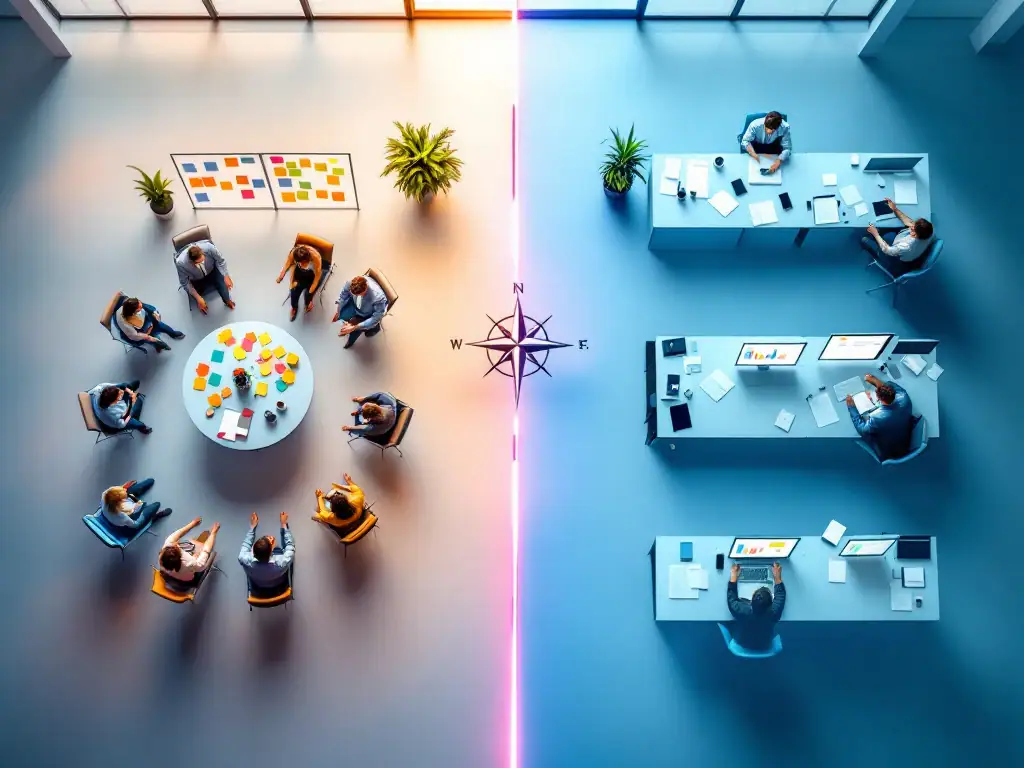
Agile and PRINCE2 differ fundamentally in approach and philosophy. Agile is a flexible, iterative method that adapts to changing requirements, with short feedback cycles and self-managing teams. PRINCE2 is a structured, planned approach with clear phases, documentation and governance. The difference is mainly in flexibility versus control. You can choose Agile for innovative projects with changing requirements, while PRINCE2 works better for projects with clear scope and strict requirements.
What is the difference between Agile and PRINCE2?
The main difference between Agile and PRINCE2 is in their underlying philosophy. Agile was born from the need for flexibility and rapid adaptation, while PRINCE2 was developed from the need for structure and control.
Agile is all about agility. You work in short iterations (often called 'sprints') of usually 2-4 weeks. After each iteration you deliver a working product, collect feedback and adjust the plans. This allows you to respond quickly to changing circumstances.
PRINCE2 (PRojects IN Controlled Environments), on the other hand, follows a more linear approach. You first carefully plan the entire project, define phases with clear deliverables, and continuously check whether you are still on track. The emphasis is on structured project management with clear documentation, roles, and responsibilities.
In terms of organization, Agile works with self-managing teams that have a lot of autonomy, while PRINCE2 has a clear hierarchy with a project board and project manager who make decisions. The relationship with the customer also differs: with Agile there is constant involvement, with PRINCE2 mainly at predetermined moments.
| Aspect | Agile | PRINCE2 |
|---|---|---|
| Philosophy | Flexibility and adaptability | Structure and control |
| How We Work | Iterative and incremental | Systematic and process-oriented |
| Documentation | Minimal, focus on working products | Extensive, formal recording |
| Team structure | Self-managing teams | Hierarchical structure |
What are the basic principles of Agile?
Agile is based on four core values and twelve principles from the Agile Manifesto. These guiding principles emphasize the importance of people, collaboration, flexibility and delivering value.
The iterative approach is characteristic of Agile. Instead of one large final product after months of development, you deliver a working partial product every few weeks. This provides quick insight into what works and what doesn't, and allows you to make timely adjustments.
The customer is central in Agile. You involve them intensively in the development process and continuously ask for feedback. This way, the end result is better aligned with what the customer really needs, even if that changes during the project.
Self-managing teams are another important principle. Teams have a lot of autonomy and decide for themselves how to approach the work. There is less hierarchy and more trust in the knowledge and skills of the team.
Continuous improvement is baked into Agile through regular retrospectives. The team reflects on what went well and what could be improved, and adapts its methods accordingly. This focus on learning and improving ensures that teams become increasingly effective.
What exactly does PRINCE2 entail?
PRINCE2 is a structured method for effective project management . It offers a step-by-step plan that guides you from project start to completion, with clear processes for each phase.
The method is built around seven principles, seven themes and seven processes. The principles, such as 'learning from experiences' and 'customization for the project environment', form the basis. The themes, including business case and risks, indicate what you should pay attention to. The processes describe what you should do and when.
A core feature of PRINCE2 is its clear governance structure. There is a project board with representatives from the business, users, and suppliers, who make decisions jointly. The project manager has clear powers and responsibilities.
PRINCE2 places great value on documentation. There are templates for project initiation, progress reports, risk management and more. These help to record decisions and maintain an overview.
The method works with controlled phases. At the end of each phase you evaluate the progress and decide whether the project can continue as planned. This gives control and the possibility to adjust if necessary.
When do you choose Agile and when do you choose PRINCE2?
The choice between Agile and PRINCE2 depends on several factors. For projects with unclear or changing requirements, Agile is usually the better choice. Think of innovative software development where you discover along the way what exactly is needed.
PRINCE2 works better for projects with a clear scope and fixed requirements. For example, infrastructure projects or implementations where the outcome is already well known and strict control is important.
The organizational culture also plays a role. Agile suits organizations that value autonomy, experimentation and rapid adaptation. PRINCE2 is better suited to organizations that work in a structured manner and value clear hierarchy.
Project size is another factor. Agile works well for small to medium-sized projects but can be challenging for large, complex projects with many dependencies. PRINCE2, on the other hand, scales well to larger projects with many stakeholders.
The risk profile also plays a role. PRINCE2 offers more control and overview for high risks and large investments. Agile is preferred for projects where the risk lies mainly in whether the end result meets the need.
Can you combine Agile and PRINCE2?
Yes, you can combine Agile and PRINCE2 into a hybrid approach that offers the best of both worlds. PRINCE2 Agile is an official method that does exactly this: the flexibility of Agile within the structured framework of PRINCE2.
In this combination you use PRINCE2 for the overall project structure, governance and business case. You work with clear phases and decision moments. Within that structure you apply Agile for the actual execution, with sprints, daily stand-ups and continuous involvement of the customer.
The advantage is that you have both flexibility and control . The project board maintains an overview of the big picture and budgets, while the teams can respond nimbly to changing insights.
This approach works particularly well for larger organisations that need reporting and control on the one hand, but at the same time want to use the advantages of Agile. This combination can also provide a solution for complex projects with many stakeholders.
For a successful combination it is important to make clear agreements about where the boundaries lie between Agile autonomy and PRINCE2 governance. This prevents teams from feeling limited or managers from feeling like they have lost control.
What are the key lessons and takeaways?
The key insight is that there is no universal best practice. The choice between Agile and PRINCE2 depends on your specific situation, project goals and organizational culture.
Understand that both methods have different strengths. Agile excels in adaptability and customer engagement, while PRINCE2 excels in structure and control. Choose consciously what is more important for your project.
Don't be afraid to mix and match. Many organizations have found success with a hybrid approach that leverages the strengths of both methods, tailored to their specific needs.
Focus on the underlying principles rather than blindly following the rules. Both Agile and PRINCE2 are ultimately means to achieve better project results, not ends in themselves.
Invest in training and culture change. Implementing a new project methodology requires more than just new processes – it also requires a different mindset and way of working.
Project management is ultimately about delivering value. Whether you choose Agile, PRINCE2 or a combination, always keep in mind what the project should deliver for the organization and end users.
Would you like to know more about how to effectively apply these methodologies within your organization? Please feel free to contact us. We are happy to help you choose and implement the right project approach for your specific situation.