

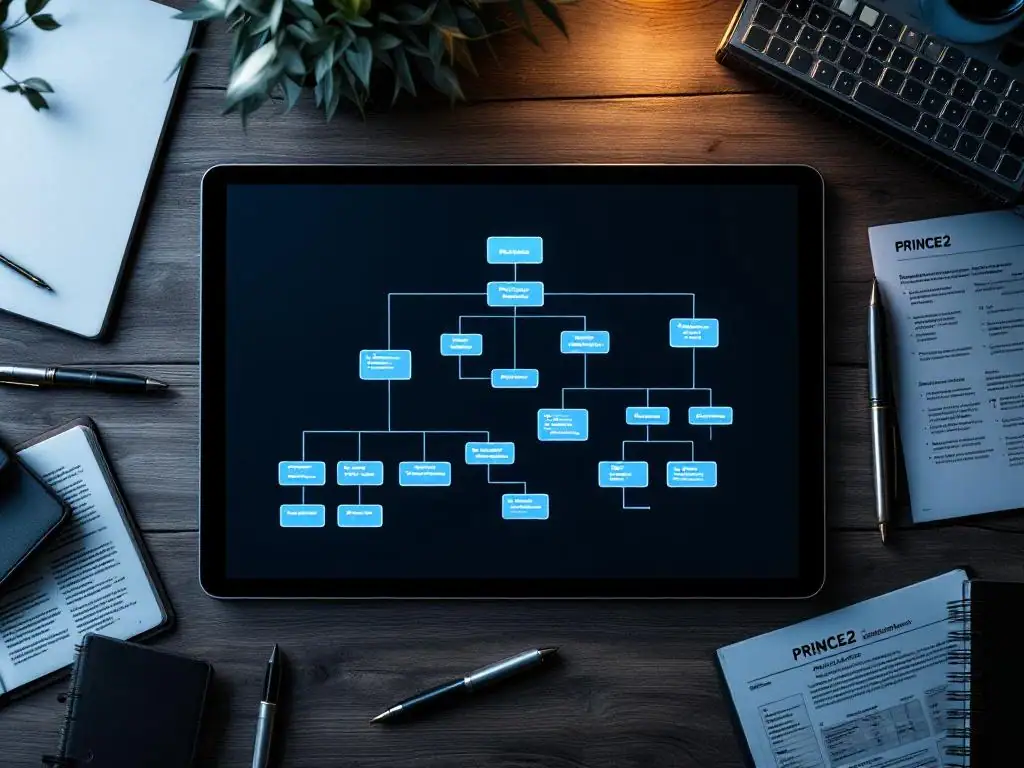
Creating a product breakdown structure in PRINCE2 starts with identifying your project's final product. You gradually break this main product down into smaller, manageable parts until you have concrete, deliverable products. This helps you gain a clear overview of what your project will deliver and how all the parts are interconnected.
Introduction to product breakdown structure in PRINCE2
The product breakdown structure forms the basis of every successful PRINCE2 project. This method helps you make complex projects manageable by clearly mapping out everything you deliver.
Instead of focusing on activities, PRINCE2 focuses on products. This means that you first determine what you want to deliver before figuring out how to do it. This approach works particularly well for organizational change and agile transformations.
The product breakdown structure gives your team a shared understanding of project goals. Everyone knows exactly what's expected and how the various components fit together. This prevents misunderstandings and ensures better collaboration.
What is a product breakdown structure in PRINCE2?
A product breakdown structure is a hierarchical representation of all products your project delivers. It shows how the final product is built from smaller parts, similar to a family tree.
This structure differs from traditional work plans because it doesn't show what you do, but what you deliver. The end product is at the top, below that are the main deliverables, and these are further broken down into smaller and smaller components.
Within the PRINCE2 methodology, the product breakdown structure works closely with other components. The product descriptions provide details about each product, while the product flow diagram shows the order in which you deliver the products.
For project management, this means you have a clear picture of the project scope. You can better estimate how much time and resources you need, and stakeholders understand exactly what to expect.
How do you start creating a product breakdown structure?
Start with the final product of your project. Write this at the top of your structure and ask yourself: what are the main components that together form this final result?
Gather input from your key stakeholders before proceeding. They often know best which components are truly important and what requirements are required for the final result.
Clearly define your project objectives. These will help you determine which products fall within your project's scope and which don't. Discard anything that doesn't directly contribute to your objectives.
Use existing documentation such as project assignments, contracts, or previous projects. These often contain valuable information about what's expected and what deliverables you need to deliver.
What steps do you follow when detailing products in PRINCE2?
Start by developing product descriptions for each product in your structure. These descriptions include the goal, the composition, which other products are derived from, and who is responsible for the delivery.
Establish quality criteria for each product. These criteria clarify when a product meets expectations. Consider aspects such as functionality, performance, user-friendliness, or compliance requirements.
Define acceptance criteria that indicate when a product is officially approved. This prevents discussions later in the project and ensures that everyone has the same expectations.
Check that each product in your structure actually contributes to the final result. It's best to eliminate products that don't clearly add value to keep your project manageable.
| Element | Description | Example |
|---|---|---|
| Product Description | Purpose and composition of the product | Training materials for new software |
| Quality criteria | Measurable requirements for the product | 95% of users understand the manual |
| Acceptance criteria | Conditions for approval | Approval by training manager |
How do you validate and maintain a product breakdown structure?
Organize regular review sessions with your stakeholders to check the structure. Schedule these sessions at different stages of your project so that you can make adjustments in a timely manner.
Use checklists to check that all products are completely described and that the structure is logical. Also, check for missing or duplicate products.
When scope changes, adjust the product breakdown structure immediately. Document these changes carefully and communicate them to all stakeholders. This prevents confusion and ensures everyone is working with the same information.
Maintain a version control system for your product breakdown structure. This helps you track changes and revert to previous versions when necessary.
Key takeaways for an effective product breakdown structure
Focus on products instead of activities . This helps your team work in a results-oriented manner and gives stakeholders a clear picture of what they can expect.
Actively involve your stakeholders in developing and validating the structure. Their input ensures you don't miss anything important and increases the acceptance of your project.
Keep your structure up-to-date throughout the entire project. Changes are normal, but make sure you document them properly and communicate them to everyone involved.
Use the product breakdown structure as a foundation for your planning and risk management. A good structure makes it easier to create realistic time estimates and identify potential problems early.
This approach offers additional benefits for organizational change and agile transformations. You can deliver value incrementally, and stakeholders regularly see concrete results, increasing change acceptance.
Would you like to learn more about effectively applying PRINCE2 in your organization, or do you have questions about creating a product breakdown structure? Feel free to contact us for a personal consultation where we can explore the possibilities for your specific situation together.