
Yara: “Through VertX, I have seen the added value of Obeya boards at many organizations. During various assignments, I noticed that knowledge of the day-to-day operations is essential. If that knowledge is lacking, it impacts the progress of your projects. Your position plays a role in this. If you hold a higher position or have multiple roles, you gain access to that knowledge more easily. I saw Obeya as an opportunity to make access to knowledge less role-dependent.”
Miranda: “Yara and I regularly work together at clients' sites. We also discuss the challenges we encounter on various projects. When Yara shared her observations, we both saw the opportunity to do something about it with Obeya. After all, Obeya helps to 'neutralize' this playing field. In an Obeya room, everyone receives the same knowledge and everyone discusses it. Any additional knowledge that emerges is immediately shared with everyone.”
Knowledge from the head on the wall
Yara: "What makes it difficult in large organizations is that there are often multiple programs running simultaneously for similar goals. And it often happens that the projects are supported or positioned within different programs. That quickly leads to a real puzzle: okay, but which program is for what? Is it all the same? And... aren't we doing things twice?
A program manager is in a position to oversee this and, from that position, can make clear decisions. The knowledge required for this is largely absent, if at all, from colleagues' heads. With Obeya, we organize the process by literally putting the information from everyone's head onto the wall. This way, everyone has the same knowledge and the same overview.
An Obeya consists of three walls. You can also link it to the "Plan-Do-Check-Act" improvement cycle.
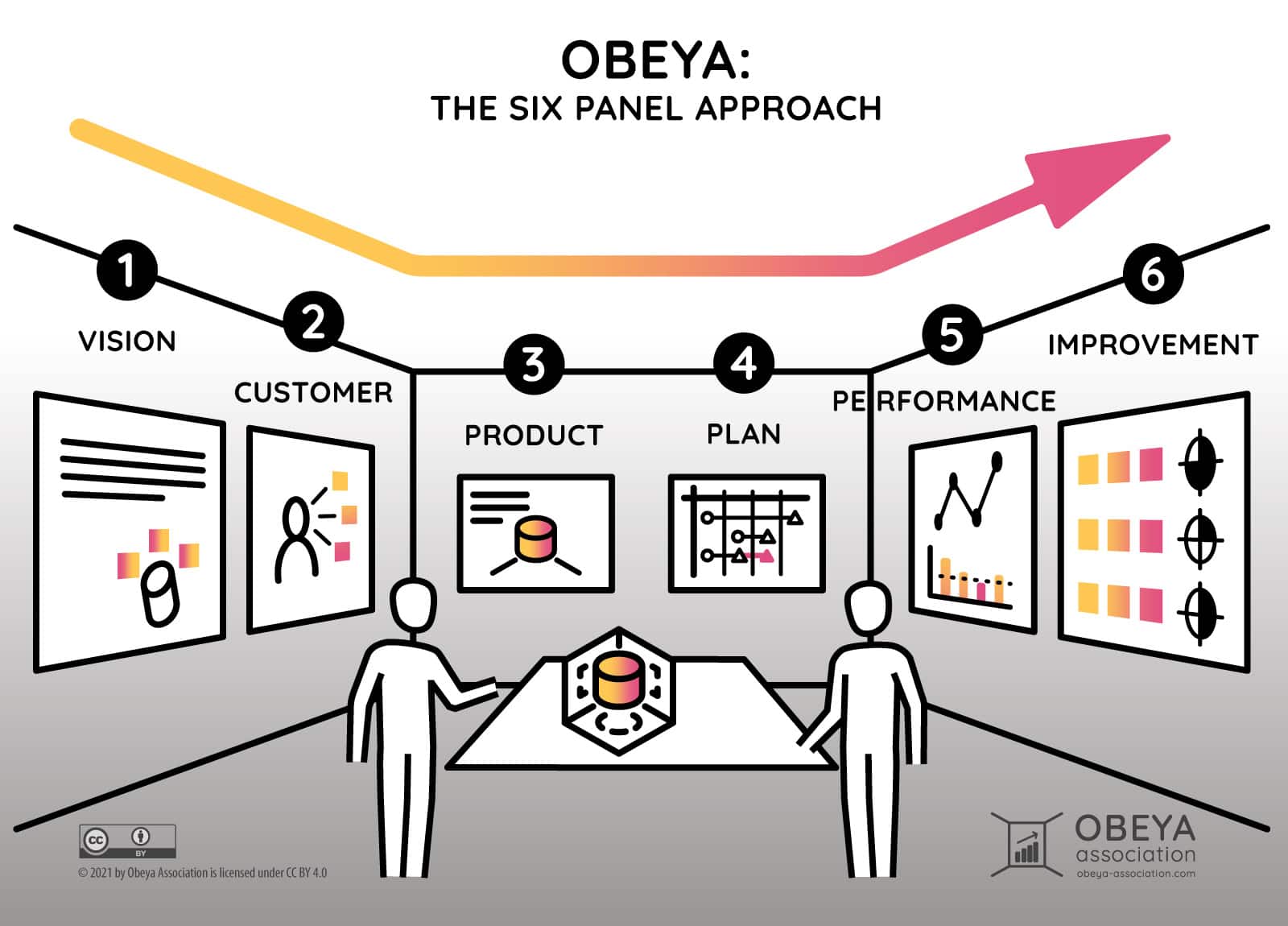
Left wall: the strategy wall. On it are your mission and vision, but also your goals and your personas. The people for whom you do it. What are their wishes? This is your 'Plan'.
Center wall: the performance wall. It consists of two parts: planning and performance. Here you can see where you stand. The planning is the 'Do', the performance is the 'Check'.
Right wall: the activity wall. That is where your actions, risks, and measures are listed. This is your 'Act'.
Conversations that would otherwise never happen
Miranda: “Within projects, it is important to inform stakeholders. What you often see happening within an organization is that one person reports and another does too, but all in a different template or using different words. That causes noise. Obeya ensures that you are all looking at the same thing, causing that noise to disappear.”
In addition, efficiency increases between teams. Team A sees exactly where Team B stands and what challenges they're facing. This makes it easier for one team to reach out to the other and say, "Do you have a problem there? I can help you." Or, "You're running a bit behind schedule, good to know."
Yara: “Obeya makes it easier for a program manager or project manager to stay focused. And sometimes, during a project, you discover things you didn't know. Maybe something isn't smart or pleasant; with Obeya, you bring that to the surface faster.”
The difference between a conversation in an Obeya room and general team sessions is therefore significant. Often, in a team session or a weekly start, you discuss current affairs at a task-oriented level. The connection to overarching issues doesn't happen.
Completing the strategy wall, the left wall, can spark a conversation about "who are we actually doing this for?" The image colleagues within a (project) team have of the target group often turns out to be unclear or inconsistent.
This is how valuable conversations arise in an Obeya room. Conversations that might not otherwise happen. And yes, that can be frustrating, but you do move forward together.
Miranda: “I 100% agree with you on that. Just pausing together to consider your left wall, the question of what your mission and vision are, provides so much insight. As soon as you answer the question—why are we here and how does that link to what we do—the follow-up question of *who* you are doing it for naturally arises. That immediately removes a lot of noise and helps you stay focused together.”
Obeya bridges the gap between strategy and execution
Miranda: “With an Obeya, you also create more mutual understanding. Because teams have the overview, they look beyond just their own tasks. They see the interconnections.”
And if you have a clear compass, direction is also easier. Then working on a project comes more from intrinsic motivation instead of "we're just doing this because the program manager says so."
For me, Obeya is primarily about communication and shared understanding. Within projects, there's often a gap between strategy and execution. Obeya bridges that gap. You bring those worlds together. Everyone sees the same thing, understands why things happen, and can therefore execute better and with greater focus.
Obeya as a foundation for continued development as an organization
Yara: "For me, Obeya is a way to learn to look at your project, program, or organization differently. But it's also a way to create space. So, slow down for a moment, zoom out for a moment.
And what I personally really like is that it also offers the opportunity to bounce ideas off each other. By exploring together: where are we clashing? Why is that, and what can we learn from it together? That's what I find really cool about Obeya; you have conversations you wouldn't normally have.
Obeya is a tool in a sense, but it's broader than that. If you use it correctly, it creates an infrastructure that allows movement to emerge. Obeya then becomes a foundation that helps your entire organization continue to evolve.