

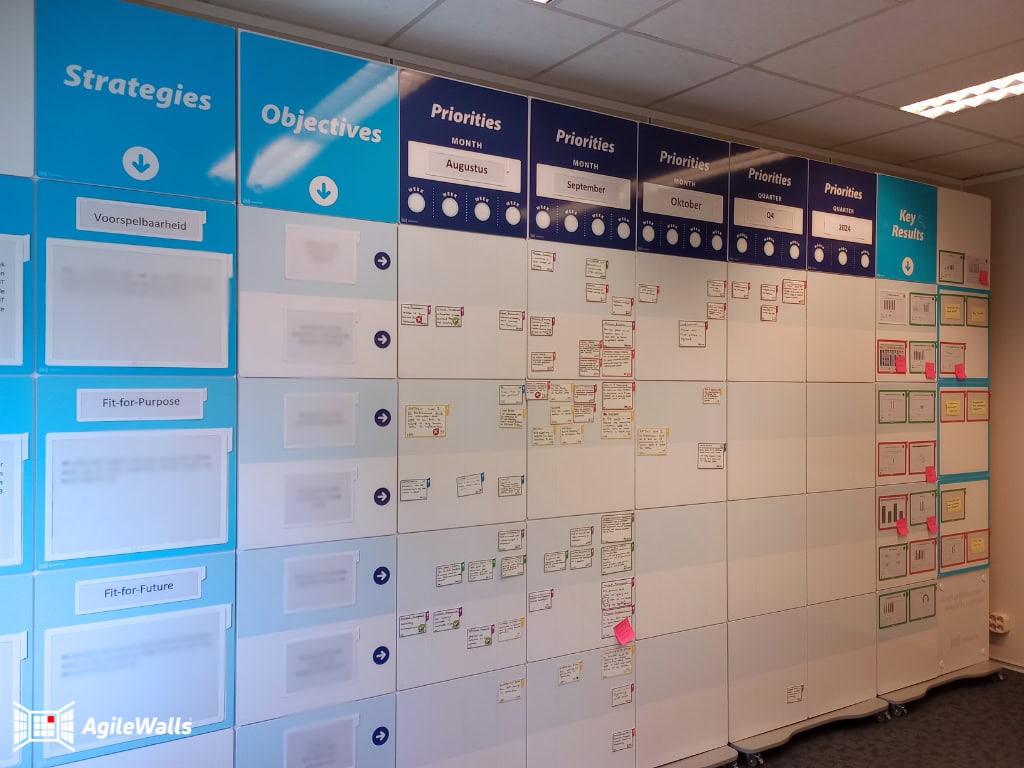
A well-designed Obeya room provides a single physical space where all relevant information, stakeholders, and decisions converge. This way, you can immediately see where you stand. The key lies in a step-by-step approach: first, clearly define your goal and scope, then design the space with thoughtful visual management and ensure clear roles and a consistent workflow.
What is an Obeya Room and Why Does it Work?
Obeya is Japanese for "large room" and originates from Toyota's Lean philosophy. The principle is both simple and powerful. With Obeya, all parties involved in a project regularly meet physically in a single space where all project information is visually displayed.
Imagine walls full of overviews: goals, ongoing projects, KPIs, risks, and areas for improvement. By making information literally visible, you enforce transparency. No one can hide behind emails or reports that disappear into desk drawers. Problems are identified more quickly, decisions are made more quickly, and collaboration intensifies.
Think of the Obeya room as the beating heart of your project. While digital dashboards often get lost in tabs, a large board with red status indicators on the wall immediately demands attention.
Determine the purpose and scope of your Obeya room
Before you start putting up signs and inviting people like a madman, first determine: what exactly will you be using the Obeya Room for? What do you want to achieve with your Obeya? An Obeya can fulfill various functions, from strategic program monitoring to operational project management.
Ask yourself these key questions:
- Which project or program will you manage with this?
- Who are the primary stakeholders and decision makers?
- What information is really critical for management and decision-making?
- How often do people physically come together for an Obeya run?
- What are the main challenges you want to solve?
An Obeya room for an IT implementation project requires different information than an Obeya for a strategic transformation program. The former focuses on sprint progress, technical roadblocks, and deployment schedules. The latter focuses on strategic goals, budget control, and organizational change.
Also, make a conscious choice about the scope: will you focus on a single project, or will you manage multiple interrelated initiatives? A scope that's too broad will clutter the space; a scope that's too narrow won't deliver enough added value to bring people together consistently.
Design and visual management of the space
The physical layout largely determines the success of your Obeya. You need a space large enough for everyone involved to stand or sit comfortably, with sufficient wall space for displaying information.
A good Obeya has three walls, each with its own function:
- Left Wall – Strategy and Direction
This is where you present the organization's mission, vision, core values, and strategic goals. This wall is relatively static and is updated, for example, once a year.
💡 Tip: this is where you keep the long term in focus
- Middle wall – projects and initiatives
This wall shows which projects contribute to the strategic goals. Think of KPIs, programs, and improvement initiatives. The middle wall bridges the gap between strategy and execution.
- Right wall – actions and bottlenecks
This is where the dynamics arise. This wall displays ongoing activities, current blockages, and new insights. During the Obeya run, you discuss what's happening, what's being added, or what's being removed. This is precisely where the power of visual management comes to life: it immediately becomes clear where priorities need to be prioritized.
🎓Do you want to learn how to build and structure an Obeya? Check out the Obeya Builder Training.
Adding visual structure
By using different colors, you visualize the status of your project. Red represents risks and blockages, green indicates things that are on track, and orange indicates areas of concern. This visual grammar should be immediately understandable to everyone, without explanation. Use this color coding consistently to ensure everyone is speaking the same language.
You don't necessarily need expensive tools to set up an Obeya room. Colorful post-it notes, flip charts, magnetic boards, and simple A3 dashboards all work perfectly. The key is that information remains tangible, visible, and adaptable.
Digital screens can be a supplement, but they don't replace the physical format. Always ensure there's enough whiteboard space, so you can immediately capture new insights during your run. It's also helpful to keep the barrier to change as low as possible. So keep things simple with tape, markers... and a healthy dose of humor.
Keeping information up to date
An Obeya room that is not up to date quickly loses credibility. Explicitly designate someone responsible for updating the visualizations. This is usually the Obeya Host , the person who facilitates the runs, monitors the flow, and ensures that everyone remains involved.
The Host ensures that every wall is solid and the information is reliable. Do you want to learn how to fulfill this role professionally? Take the Obeya Host Training.
Make updating a regular part of your work rhythm: after every sprint review, steering committee meeting, or at a fixed time each week, all walls are updated.
Determine roles, rhythm and consultation structure
An Obeya room without structure is just a meeting room with paper on the wall. Its power lies in the rhythm at which people come together and the roles they play.
Who does what in the Obeya?
The program manager or senior project leader is often the owner of the Obeya. The Obeya Builder designs and builds the space: he ensures that the three walls are logically arranged, that strategy, projects, and actions are connected, and that everything is visually correct.
The Host then facilitates the runs, monitors progress, and keeps the energy high, while team leads, experts, and stakeholders actively contribute. Not everyone needs to be present at every run, but you do need the right people for decisions. The Host ensures that this runs smoothly.
Steady rhythm and various Obeya runs
Want to make your Obeya a real success? Then work with different run formats:
- Daily stand-ups (15 min) – short and sweet: status, blocks, actions.
- Weekly progress runs (60–90 min) – with a focus on progress, risks and decisions.
- Monthly strategic reviews (2–3 hours) – to discuss trends and recalibrate course.
Consistency is crucial here. Cancellations and postponements undermine confidence in the approach.
Facilitating Effective Obeya Runs
During an Obeya run, everyone stands, literally! This keeps things short, energetic, and focused. Always start with the strategic goals (left wall) and then work your way down the center wall to the actions and bottlenecks (right wall). This keeps the connection between strategy and execution alive.
Use the walls as a guide for the conversation. Explore the themes, ask insightful questions, and immediately capture new insights. Decisions are made and documented on the spot – no more endless parking spaces for action items.
End each run with a clear summary: what was decided, who does what and when do we evaluate?
Implementation and further optimization
Treat the first few months with an Obeya room as a journey of discovery. What works and what doesn't? What information are people missing, and what are you secretly not using at all? Give yourself and your team the space to learn and adapt. Once you've mastered Obeya, it will start working for you.
Starting with a pilot
As logical as it sounds, it's often forgotten: start small. Choose one project or part of a larger program to test the Obeya approach. After 4 to 6 weeks, evaluate what can be improved. Gather feedback: do people feel better informed, are decisions made faster, do they experience more collaboration?
Based on this evaluation, you adjust the layout, rhythm, or runs. An Obeya is never "finished," it grows along with the project.
Avoid common pitfalls
Okay, now we're going to cram EVERYTHING into the Obeya…
Nope, that's not a good idea. Trying to process too much information is a classic mistake. So resist the urge to hang everything on that wall. Focus on what's truly relevant for management and decision-making.
And then there's another pitfall: the lack of commitment from management. If senior management doesn't check in regularly and actively participate, the Obeya quickly loses its effectiveness. Ensure that key figures remain visibly involved. The Obeya Host plays a crucial role in this.
Digitizing the Obeya can also be counterproductive. Because yes, a digital version helps for remote teams, but the physical element—standing together, pointing, and looking at the same wall— that's where the magic happens! ✨
Embedding Obeya into the organizational culture
Have you found the Obeya approach effective? Great, now you can use it more broadly. Give multiple projects their own rooms. Or you can even create a portfolio Obeya where leaders share their progress and manage dependencies.
And last but not least: invest in training. Visual management and transparent collaboration require a slightly different mindset. Training helps people become familiar with this super-effective way of working.
Would you like to dive deeper into this? Check out the Obeya Fundamentals Training.
Bring focus, speed and collaboration together
Let's recap! An Obeya room is much more than a beautifully furnished meeting room with cozy stickers. Obeya is the working method that enhances focus, speed, and collaboration. By making information physically visible, bringing stakeholders together systematically, and making decisions on the spot, you create a dynamic that drives projects forward.
So start with a clear scope. Then, set the stage with well-thought-out visualizations. Ensure clear roles and a consistent cadence, and keep optimizing. Rest assured that your investment of time and resources will pay off. Obeya leads to better decision-making, fewer surprises, and a team that truly collaborates.
Want to learn more about how to optimally use Obeya in your organization? Check out our training courses:
👉 Obeya Host Training
👉 Obeya Builder Training
👉 Obeya Fundamentals Training

Bring your project to life: get your Obeya certification with Lagant!
After completing the course, you can take the exam for the official Obeya Fundamentals certificate from the Obeya Association. This certificate is internationally recognized and included in the training price. Upon completion of the certification, you can also receive a free one-year membership to the Obeya Association.
How big should an Obeya room be?
That depends on the number of participants and the amount of information you want to visualize. For a team of 10 to 15 people, a space of 20 to 30 square meters is sufficient, with at least 12 to 15 square meters of wall space.
Can an Obeya also work digitally?
Digital tools can help remote teams, but Obeya's real power lies in facing the same walls together. Without that physical aspect, you lose some of that energy. So, while it's possible, a physical space takes collaboration to the next level.
How much time does it take to maintain an Obeya room?
That's hard to say. How much time you'll spend maintaining your Obeya room depends entirely on its complexity. It could be half an hour a week, or even two hours. Maintenance is absolutely crucial! Linking updates to regular runs keeps things organized.
Which projects are best suited for Obeya?
Complex projects with many stakeholders and dependencies, such as IT implementations, product development, or organizational change.
What if managers have little time for Obeya runs?
Turn it around! Obeya will actually save you time. Busy managers, in particular, benefit from its efficiency: one hour in Obeya yields more insight than 10 emails and three meetings.