
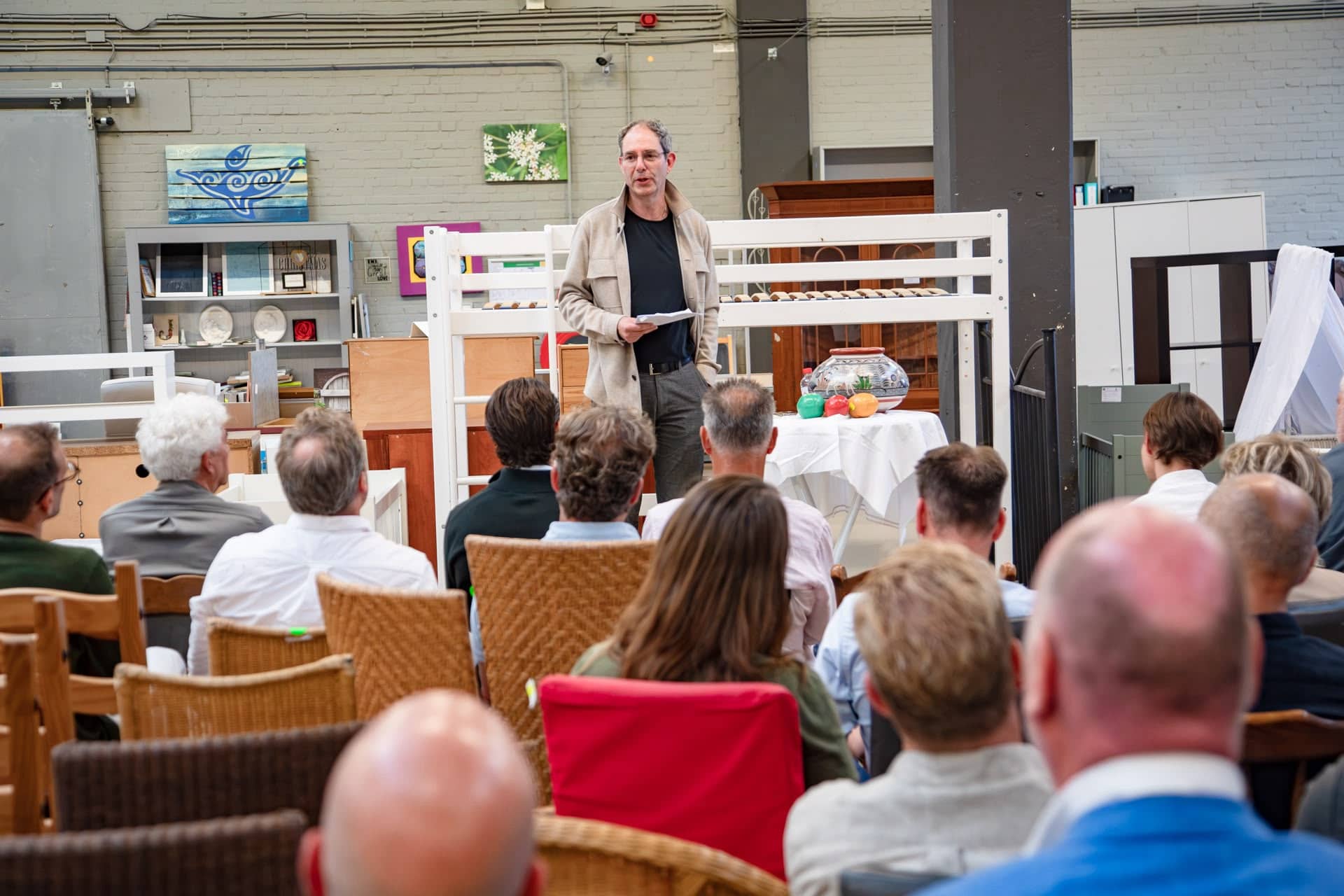
Every year, more than 3 million kilos of goods arrive at Kringloop Amersfoort. Items with a story: discarded by one person, but a total discovery for another. It is precisely at this location that Masters of Business is organizing an evening centered around the theme of 'Second Chance'. One of the speakers this evening is our own trainer and change expert. Orlando Heijmerink.
Prior to the evening, Orlando is given a tour by director, board member, and inspirator Karima Bouchtaoui. Karima explains that the thrift store attracts over 250.000 visitors annually and helps people facing barriers to employment find work. What a beautiful location for this gathering.
During the tour, Orlando's eye falls on a Mexican vase. Where others might think, "Okay, a Mexican vase… so what?", this is special to Orlando. After all, he was born in Mexico City. Orlando doesn't hesitate for a moment and buys the vase. This is also how he opens his story for the audience.
Through which lens you look
'Take a look at this vase,' says Orlando as he shows his new acquisition to the audience. 'Nice? Or maybe a bit expensive for that €18? For me, the meaning of the vase goes beyond something you can put flowers in. This vase comes from Mexico, the country where I was born.'
At Orlando's home, there were objects like this everywhere. 'So it's not about what you see at first glance,' he explains. 'It's about the value you assign to something, or the lens through which you view it.'
From banker to change expert
Orlando had often looked at things from a different perspective in his life. He worked at ABN AMRO for twenty years. He had a good position, a hefty salary, and all the status that comes with it. Yet, at a certain point, it began to gnaw at him: he wanted to add more societal significance than a banking job could offer him.
So he switched to Lagant. A place where he could actually make that impact. But at the same time, he saw his income halved. 'I really had my doubts,' Orlando says. 'What am I actually throwing away?' The answer came when he sat down with his wife. Together, they discovered that they could manage perfectly well on half. That realization—that you are valuable as a human being even without status and wealth—was at least as meaningful as the switch itself. So, supported by his wife, Orlando made the choice to go for it.
'Ultimately, it wasn't so much my bank account that changed. It was mainly the lens through which I viewed my life,' Orlando explains to his audience. This different perspective was a total liberation. Or, as Orlando puts it: 'I'm in charge of everything entirely on my own.'
Reflection as a habit
Orlando is Jewish, which occupies an important place in his life. Coincidentally, it is this time of year for the Jewish New Year. During the Jewish New Year, it is the tradition to blow a shofar, a ram's horn with symbolic meaning: the sound is a call to repentance.
Orlando: 'For me, this is the time to look back on the past year. How did I act? What choices did I make? Do I need to set something right, do I have something to forgive, or is it time to choose something different?' He links this reflection to the theme of the evening, the second chance: 'So, the second chance is not about erasing the past,' says Orlando. 'It is a conscious choice to look at it differently and to deal with it differently.'
Why change stalls
Daring to look at things differently and reflect has a direct link to his profession. As a change expert, Orlando is often asked the same question: how do you deal with resistance? His answer goes a layer deeper: 'At the core, the real opponent of change lies elsewhere. It lies in the way you yourself view reality. Your interpretation of reality stands in the way of perhaps being able to see a different reality,' says Orlando.
A different perspective on things, or to stick with the metaphor: putting on a different pair of glasses, doesn't happen overnight. 'People don't want to be changed,' says Orlando, 'but they are quite willing to change.' The difference lies in willingness *and* in whether someone learns to look at things differently. 'Because,' Orlando adds, 'before people act differently, they first have to learn to look at things differently.'
He therefore does not view his role as a change expert as a matter of steering, pushing, or pulling. 'My role as a change expert is to organize a dialogue, to connect perspectives to bring people along in that process,' he says. 'Change always happens between people, and begins with the willingness of the individual themselves.'
Look again
Orlando concludes with an appeal to his audience: 'Take a look at yourself, your partner, your children, or your colleagues. Perhaps there is someone or something there that you could well take another look at. A second chance always begins with a second look.'
Do you want to learn how to initiate change without fighting resistance? Check out our training courses and discover how to connect different perspectives.